

The Long Game
Don Paterson on the truth about iron, spiders and milk


I’ve spent most of the last two years writing a second volume of memoir. I finished it a few weeks ago, whacked it off to the publisher, then had to be physically prevented from putting all my guitars on eBay. To hell with prose, honestly: I’d developed such bad RSI from typing ten hours a day, I was convinced that I’d permanently destroyed my hands. One of the last things I flew in before the two of them finally gave out was a short passage about my late friend, Michael Donaghy. I’d forgotten to mention that I had first encountered Mikey in print, shortly before I met him in person, at Colin Falck’s legendarily brutal Hampstead workshop in 1989.
Young, ambitious, unpublished and deranged by testosterone, I was in the library giving the new Poetry Review a thorough ground-strafing one day, mostly trying to dismiss the male competition as swiftly as possible, when I came across a photo of a disgustingly handsome guy. This augured well, since the chances of someone being both this freakishly adonic and talented were about zero. The poem was called ‘Smith’. I scanned it quickly, like a bus timetable. Something about signatures and personae. Ok, so he’s literate, I conceded. I read the thing properly. To my dismay, the poem appeared to be quite good; it was confident, but unselfconsciously so. Then I read it again. Ok, ok – justifiably so. Thing were looking worse and worse. Oh no... The poem was good. Actually: it was really, really good. I read it once more, forgot to look for things wrong with it, and took a much simpler delight in it being plainly wonderful. Its tale was compelling, beautiful, funny – but most strikingly, inevitable: every new detail boldly advanced the plot, and yet seemed a callback to every other. I felt like I’d known it forever, or at least the truth of it. And it reminded me why I was in this game in the first place, which was not to hate-read Poetry Review. I really did love poetry, and I’d briefly been in danger of forgetting.
‘Smith’ is a poem about self-identity and the written signature, and how you learn to ‘forge’ them, both in the sense of ‘create’ and ‘fake’; the poem might even propose the interchangeability of the two terms. The episode described at the end of the poem is a memory ‘in every infinite detail indelible’, recovered from a scorching summer, long, long ago: two awkward young lovers sign in anonymously to a cheap hotel (‘surely it wasn’t – Mr and Mrs Smith?’), and then they make love. I was especially moved by the affidavit of the poem’s ending, lines far too gawky and naked to work in anything less than a little masterpiece: ‘Dear friend, whatever is most true in me /Lives now and for ever in that instant, /The night I forged a hand, not mine, not anyone’s, /And in that tiny furnace of a room, / Forged a thing unalterable as iron.’
Hangonaminute, I went, exactly 35 years too late. I can be very slow on the uptake; but did it really taken me until June 2025 – with Mikey more than twenty years dead, and my having written a book-length study of his work – to read that last line correctly? Forged a thing unalterable as iron. What the poet claims to forge here is a memory; and memory is indeed as ‘unalterable as iron’. Which is to say – I can hear Mikey in my left ear, berating me now – ‘Jesus, Donno, it’s completely fucking alterable.’ Just as iron can be heated and reshaped, so we alter our memories in the forge of our imagination and desire. One might even say that’s what we use poems for – to rewrite the facts to fit the more urgent or necessary telling.
Though that oddly over-sincere avowal should have made me immediately suspicious, especially in a poem about the twin sense of ‘forgery’. Mikey had had me again with that ending – again, ‘had’ in both senses: ‘captured’ and ‘duped’. ‘Whatever is most true in me’ doesn’t align with what I know of his work or personality. He didn't regard very much as being ‘true’ in him, and trusted himself even less to know. Michael believed in little but the value of doubt. (His poem ‘Reprimands’ drills down into its deep Catholic and Jungian roots: the double-twin St Thomas was ever his patron saint, and Mikey seemed permanently shadowed by another Mikey on an alternate timeline, always poised to make the opposite choice.)
Dear friend, whatever is most true in me ... Michael had pretty much introduced himself to me with the Cretan paradox. Paradox was where he was happiest, I learned: there’s a poem of his, ‘Meridian’, which begins: There are two kinds of people in the world. / Roughly. First, there are the kind who say / ‘There are two kinds of people in the world.’ /And then there’s those that don’t. (I once asked him which he was; he told me he was ‘unwilling to take sides in the matter’.) I met him shortly after reading ’Smith’, and in that younger and greener incarnation, I asked him if the story of ‘Smith’ was true. ‘For Chrissake of course it wasn’t!’ he answered, both witheringly and kindly. I still think it was true, or partly so. There’s no cover like the truth, as one learns. Or, precisely: there’s no cover like the truth, bar one detail. But the poem isn’t about truth or lies. It’s saying that who we decide we are – in both outward sign and inner, defining memory – is always ‘forged’. We are ‘smiths’, in both senses; nobodies, and makers of ourselves. Michael had cleverly concealed this point behind my own sentimental projection, especially my desire – let’s be blunt – for happy endings; he left it for me to discover when the time was right. It won’t be the last thing.

I’d have got to his meaning more quickly, I think, if I’d just remembered Robert Frost was Michael's favourite poet. Frost had a deep bag of tricks, but his best one is to put on the most trustworthy voice you could imagine, then look you in the eye and lie to you outright, or mutter things – terrible, did-I-just-hear-that-right things – under his breath or on the way out the door. Ivor Cutler used to say, ‘First I get them laughing, and when their mouths are open, I pour the poison in’. Frost worked with our sentimentality in much the same way.
These days the go-to, textbook example of Frost’s untrustworthiness is the rather exhausted revelation that ‘The Road Not Taken’ is not about what you think. (I’m as guilty as anyone for rehearsing this riff too often, and I apologise for autocannabalising a paywalled Telegraph article in this next bit: do skip it, if you’re too familiar with the tale.) Its fireside monologue is really a firebombing of the profoundly unhelpful ‘life is a journey’ metaphor. The poem isn’t about making a bold choice at a diverging path, but about retrospective justification: for our lives to have meaning, we often have to tell ourselves our decisions were both crucial and consciously our own. ‘I shall be telling this with a sigh / Somewhere ages and ages hence: / Two roads diverged in a wood, and I— / I took the one less traveled by, /And that has made all the difference.’
Hangonaminute. We have questions. How can we ever know? Besides, was the difference a good one? And Frost had earlier said that the paths were ‘worn about the same’, so why is he lying to himself now? That ‘sigh’ – is it pride? Satisfaction? Resignation? Regret? It all depends on ‘the voice you put on’ to deliver the last few lines. Try reading them out with a sarcastic or a weary tone, if you want to start exploring their instability. Although Frost intends that we first read it as the sigh of a pompous old man, determined to portray himself the master of his own fate. But the hero’s journey is just a distortion of the rear-view mirror. Significantly, the title is often misremembered as ‘The Road Less Travelled’, if we needed any more proof of the romantic delusions of the reader.
The poem was written partly to mock his friend and walking companion Edward Thomas, and his miserable indecisiveness when confronted with a choice of paths. Initially Thomas failed to recognise himself in the poem, and Frost had to point out the joke, even though it took half-a-dozen letters for Thomas to get it. When he finally did, he was shirty and defensive. ‘I doubt if you can get anybody to see the fun of the thing without showing them & advising them which kind of laugh they are to turn on.’ The story goes – it's too good a story to stop telling it – that the poem may have killed its addressee. As if to demonstrate that Frost had got him wrong, Thomas soon made a bold choice of his own, declaring that for him ‘all roads lead to France’ (and to his almost immediate death in action, on arriving at Arras in April 1917). Who says poetry makes nothing happen? On this evidence, though, it might be better if it didn’t. Either way, Frost’s poem remains an expert piece of misdirection, and for decades this poem has gone on using our own determined sentimentality against us. Quoted constantly, it long seemed to exist only in its completely misinterpreted form. The poem was once memorably described as ‘reader-proof’.
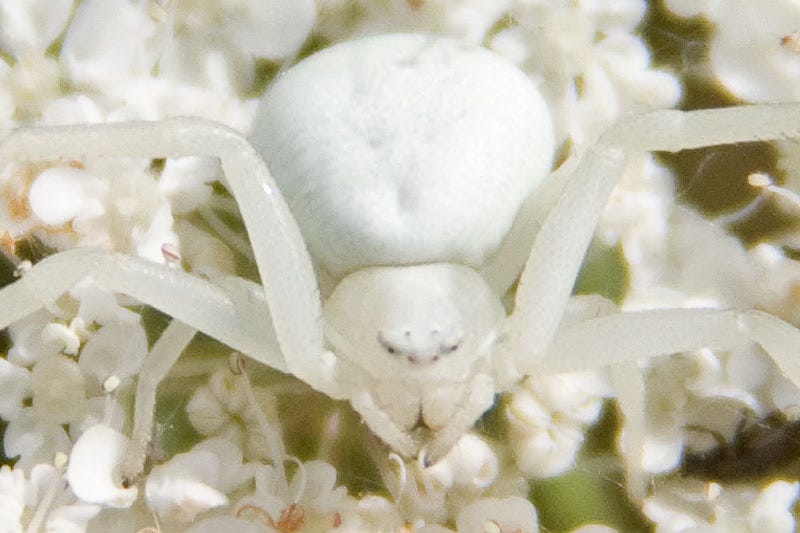
At this point, we all should've been scurrying off to the Collected Frost to find out how many other manholes lay under the hollyhocks. I’ve since found many, and I'll write about them all one day. Until recently, I thought that the worst of them was the final line of ‘Design’, whose real intentions Randall Jarrell was first to identify. Nature, in the form of random genetic mutation, has led to a little horror on a white flower-head, where an invisibly camouflaged white spider has plucked a moth from the air. ‘What had that flower to do with being white, / The wayside blue and innocent heal-all? / What brought the kindred spider to that height, / Then steered the white moth thither in the night? / What but design of darkness to appall?’ Well, indeed. If you haveto make the argument from design, you’d also have to conclude we have a pretty evil designer round here. And then Frost shrugs. ‘If design govern in a thing so small.’ But when you see what he’s really saying here, you might start to wish sonnets were only 13 lines long.
We should be even more wary of the throwaway afterthoughts of Robert Frost than his unblinking sincerities. The only time Frost is guaranteed to be trustworthy is when he’s being cynical. Otherwise, he’s often hiding something. In this case, it’s an abomination. The first time I ‘got’ this line, the temperature in the room seem to drop to freezing point. Ok: if there’s no cosmic designer, what we have here – in this little knee-height Titus Andronicus staged for insects – is just how shit goes down; this is merely the nature of physical law. Meaning that the random rules that govern this universe turn out to be an amoral enormity: our cosmos has evil written into its code, by accident. One finishes the poem desperate for the demon-designer of the previous line to come back: at least that guy was taking an interest in us.
One of his Frost’s greatest achievements was to just to smuggle himself past the reading public; no mean feat, for someone so often drawn to a terrible nihilism. But he was a man of insatiable ambition – for readers, sales, prizes, money, reputation, fame – and knew his deep-freeze rationalism was a hard sell. The con worked too well, perhaps: until fairly recently, folk would still place him somewhere between Ansel Adams and Norman Rockwell on the American spectrum of warm, fuzzy, patriotic reassurance. This makes him the definition of a subversive artist. You shouldn’t see them coming. The avant-garde, God bless ‘em, arrive with a blast of free-jazz trumpet on the back of an avant-garde parade float. They are blissfully easily to identify, and therefore – for the ‘reading public’, at least – avoid. Frost, not so much.
Which finally brings me – you come too, please, I don’t much want to go alone – to ‘The Pasture’. You’ll know it, because Frost made the poem hard to ignore. It was the introductory poem in North of Boston, and he used it as an epigraph to all the editions of his Collected Poems; he would start off most of his public readings with it. An early poem, then, but still being deployed very late. He must have been inordinately proud of it. And yet it seems a bit of a bagatelle:
The Pasture
I'm going out to clean the pasture spring;
I'll only stop to rake the leaves away
(And wait to watch the water clear, I may):
I sha'n't be gone long.—You come too.
I'm going out to fetch the little calf
That's standing by the mother. It's so young,
It totters when she licks it with her tongue.
I sha'n't be gone long.—You come too.
OK, a pretty song; nice bit about clearing the stream; maybe it’s a metaphor for poetry, or something. If you look up the poem online, you’ll probably find a twee summary along the lines of ‘Frost often used the poem as a way of introducing himself and inviting the audience to come along on his journey. This is a purpose for which the poem is perfectly suited, because that’s what it is: a friendly, intimate invitation.’
Hangonaminute. Yes, that sounds just like Robert Frost. By which I mean it really doesn’t.
I read this poem again last year, just after my ‘Smith’ facepalm. I’d paid it very little attention in the past, and had filed it under ‘elegant but sentimental post-Georgian fluff’. The fact that it was so obviously his intention that I do so should have triggered the alarms. It’s another poem Frost knew we’d all bury in ‘the fallacy of the appeal to nature’; we like to imagine that everything natural is good. But what if you come too is an invitation to witness another lesson? Look again at that word ‘fetch’, casually thrown away, like all Frost’s most incriminating evidence.
When Frost he wrote this poem – probably pre-1910 – he was living with his family on a subsistence farm. He wasn’t ever much of a farmer, but never more than he was then. (‘Pasture’ = a field for grazing; it goes back to the PIE pa–, a ‘feeding’ root which itself springs from the ‘father/provider’ root.) The spring is cleared to irrigate the pasture and keep it good for eating. Why? So the cow’s milk is good and plentiful. But milkers have to stay pregnant to stay productive. For a hundred years he invited us to imagine … What? That he was fetching the little calf in out of the rain, to put a ribbon on it and give it a name, like the farmers of our story-books? No: Frost probably only had one milker, and the milk was there to feed his family, not the little cow. It’s a veal calf. He’s fetching it for slaughter, and not for the first time. It’s heading for the truck, and the truck for the butcher. ‘It’s so young’ is a mark of the poet’s own horror. No wonder he wants company, for what is now revealed as our lucky opportunity to get further acquainted with the night.
Sorry if I just ruined the poem, but I believed we’ve been fooled again. Frost knew all about the cheerful errors committed by us glass-half-fullers, and he toyed with us mercilessly. I could be ‘wrong’, of course; after a morning scouring the shelves and JSTOR I could only locate one other source in the critical literature that had reached the same conclusion. But the point of the poem is to seek our own truth within it, and I don't think anyone will ever talk me out of this one. I just can’t unsee it now. Like the ‘kindred’ spider in ‘Design’, we are eaters, and we don’t like to be confronted with the fact. (I'll leave it for others to pursue the ‘if you drink milk, you should eat veal’ argument, which is of course just one about honest secondary consequences; all I’ll say is that no poem has brought me as close to turning vegan.)
The experience introduced a new note in my reading of Frost, which has now shifted from deep distrust to outright paranoia. Why would he do that to us? That we might eventually confront ourselves, I suppose, when the time was right. Though he must’ve been delighted to sneak this little horror past his audience, book after book, night after night, always in full view. But note that this kind of long game just isn’t possible without deep traditions of popular reading. These days, most poetry seems written with an eye on its immediate consumption, and mostly for an audience of other poets. Too often it seems to express everything either nakedly or obscurely. But what happened to wile? What happened to Antonio Machado’s entreaty to ‘light your poem from two angles: /one for the straight reading, /one for the sidelong’? Are we losing the reading traditions that might accommodate such poems? If we state the most uncomfortable truths nakedly, they’ll be rejected; if we bury them in obscurity, they’ll never be found. We will always need the plain sight that affords them a place to hide, until the time is right for them to step from the shadows.
News! Due to popular demand, we’ve decided to offer a second chance to join the next North Sea Poets course, ‘Writing With…’
This seven-week course will run on Saturdays, 11am-1pm BST, and cover everything from landscapes to ghosts, from Heaney to Plath.
Tickets go on sale at 5pm today! Get all the details at northseapoets.com 🌊
My goodness, this is so illuminating. The poignancy you reveal reminds me of Laura Gilpin's The Two Headed Calf. And thanks for the Edward Thomas clarification.
Fabulous.