

Our Spring Reading: Part I
here's what the North Sea Poets have been reading recently ... Part II to follow next week

Kathleen Jamie
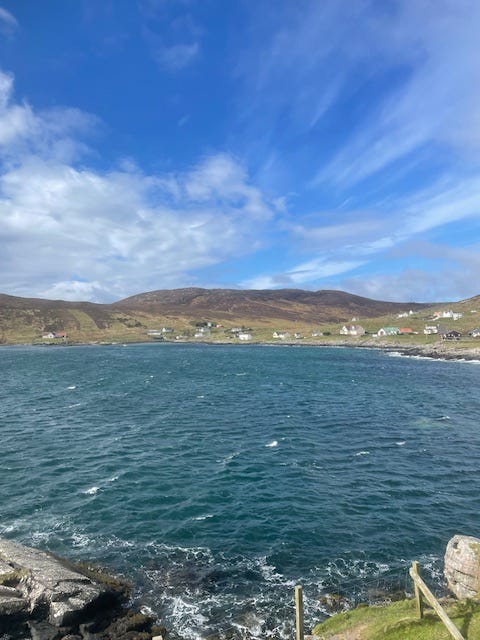
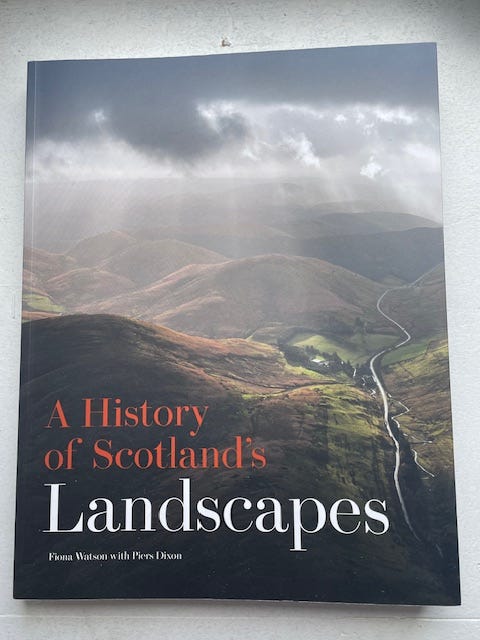
I’m presently in Barra, and brought with me A History of Scotland’s Landscapes, by Fiona Watson with Piers Dixon. I’ve always been fascinated by the evidence of the past and change in the landscape. That said, ‘evidence of the past’ is not the right phrase, it’s the co-existence of all these times in the moment of now that I enjoy. The photo shows modern houses, note, many without chimneys, and on the hillside left, an old field system. Out of sight to the right is a magnificent standing stone. You have 5000 years right there. (The photo, incidentally, was taken through the window, as I couldn’t actually open it against the wind) The book is published by Historic Environment Scotland and is brilliantly illustrated.
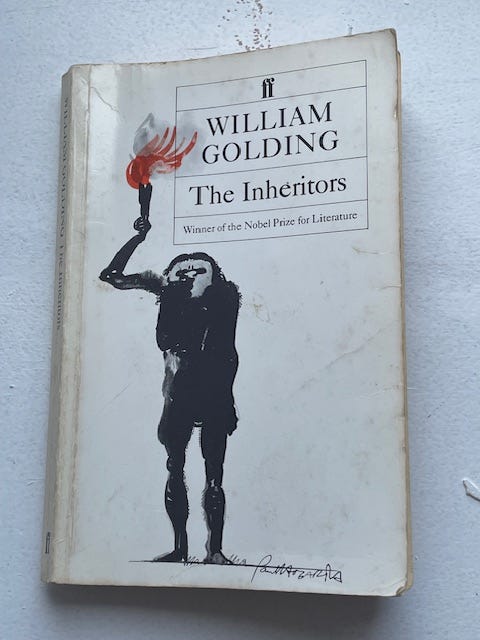
But what’s 5000 years? Just as we were leaving home I pulled from the shelf a paperback I realised I’d never actually read, William Golding’s The Inheritors. I’m half way through, our Neanderthal group is just encountering the leaner, meaner Homo Sapiens…I fear it won’t go well. Astonished to note that this was published in 1955. 70 years! Much archaeological work has been done on Neanderthals since then, but little in fiction. (We are so self-obsessed.) Golding was an early sympathiser.
Lesley Harrison
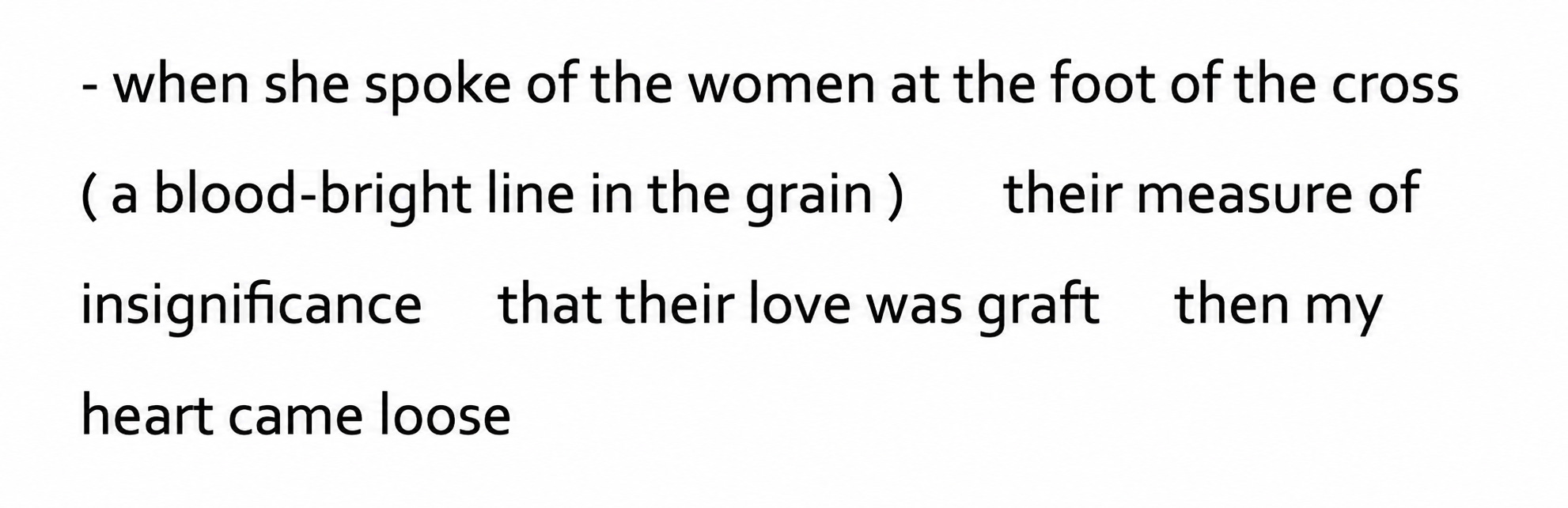
At the moment I am eagerly awaiting a delivery - Bloodroot, by Annemarie Ní Churreáin (Doire Press, Co. Galway). In the meantime I’m reading nine, by David Harsent. Poetry books should always be beautiful, and this Guillemot Press pocketbook is a lovely tactile object, grey and white and yellow, with colour images inside of a weathered, tarnished notebook. nine is a single poem; it is presented as a transcript of an archive document, of what is legibile in “a notebook found among the writer’s effects”. The resonance of archives fascinates me, and I began reading this with a slightly sceptical eye. What did he hope to gain by using this form? It definitely sounds like David Harsent, and the odd gaps and lacunae give it a rather self-conscioius breathlessness rather than a sense of something (what?) being lost through the holes in the text. But I’m still enjoying it.
Plagued recently by a spate of broken sleep, I have found companionship and an odd sense of purpose in Sleeplessness, by Marie Darrieussecq (Fitzcarraldo). It freewheels relentlessly between memoir and anthology, with that surreal sense of time and place you get when you are chronically jetlagged. “Sleep, I thought, is the other half of us ... It is us, in our absence.” Knitted through her own efforts to conquer consciousness are a whole library’s worth of quotations. (“There is nothing worse than being an insomniac in Buenos Aires.” Jorge Luis Borges.)
Very, very readable. Especially at 4 in the morning.
John Glenday
I prefer books with very short sections because my concentration span has always been so rubbish - the likes of Vonnegut’s Cat’s Cradle with its 127 chapters, or Calvino’s Invisible Cities. So Fanny Howe’s The Winter Sun has been eminently digestible, brief meditations on her life, the lives of others and poetry:
‘Revision is the opposite of repetition and religion. In the process of stripping the language back to an unnaturally naked state, you want to see what is hidden behind each word, what intention, what fact, then cover it up with something else.’
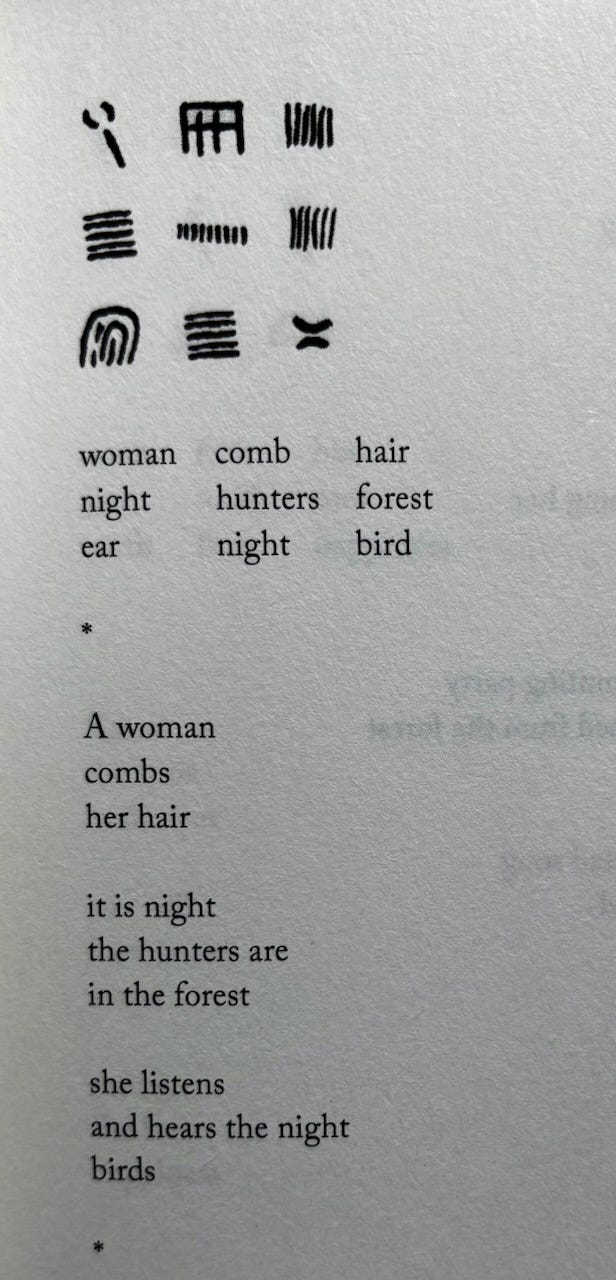
Despite warnings from accomplices, I’m also reading the wacky, tongue-in-cheek The Lascaux Notebooks by Philip Terry. Upper Palaeolithic ‘poems’ ‘translated’ by a ‘little-known French recluse’. Note all those inverted commas. It’s total nonsense but at least it isn’t pretending to be anything else, which is somewhat refreshing these days.
And lastly, Vona Groarke’s X from 2014. I bought this after enjoying her T S Eliot shortlisted Infinity Pool. I’m ashamed I’ve not spent enough time with her poetry which seems to unlock little doors towards stuff that’s going on behind the words.
Also, I can’t help but admire a poet who writes:
‘When a poet talks about ‘their practice’, I can’t help it, I think: Oh grow up.‘ Here’s a short poem from the book:
Closing Time
What you take for company
when the moon is in the rowan
and winter scratches the back door
is the offhand innocence
that would trim any given story
to suit the music of a gate
with raindrops on it
or a street breathing
through a keyhole
or a page turning in darkness
as if it had something to say.
Don Paterson
This spring I've been mostly reading books that I really thought I’d read, books that I pretended I’d read, and books that came so hysterically and frequently recommended, I imagined I’d read them. Anyway, I read 'em. I concede: Helen Garner's court-case books are wonderful and prescient and disturbing, in particular - especially for those of us interested in the literature of narcissism - Joe Cinque’s Consolation. I really was convinced I’d read Muriel Spark’s terrifying and probably-unpublishable-these-days The Driver’s Seat. Apparently not. My considered reflection is … JFC. I hadn’t expected it to put me in mind of Martin Amis’s darkest hour. Dino Buzatti’s The Tartar Steppe was a book I once claimed to have read but didn’t, because everyone made it sound exactly like Kafka. It’s not like Kafka. Not exactly. It’s quite brilliant. A young officer is posted to a frontier fortress overlooking an empty desert, where everyone waits for a possible invasion. He intends to stay only briefly. I’ll say no more.
John Glenday would love the great Thomas Bernhard’s book of whack anecdotes, The Voice Imitator, if he hasn’t read it: Bernhard sliced thin as a salad cucumber. 400 earnest young men from the ‘nice manosphere’ have popped up on my YouTube feed over the last two years yelling about James Kestrel’s Five Decembers, so I finally gave in. A noir detective novel set in the Pacific theatre in the World War II, it’s really a virtuoso piece of historical romance hiding in a violent ripper of a story, and yet another example of so-called genre kicking so-called high-end fiction to the gutter. Read it before they make a terrible three-hour movie with a miscast Timothy Chalomet.
AI will definitely kill us all, but in the meantime it’s great for ‘tell me something great I probably won’t have read’: its last suggestion was Birgit Vanderbeke’s The Mussel Feast, a single-sitting monologue which soon turns into a thoroughly unsettling essay on how families enable monsters. On AI-directed whim, I have Nawal El Saadaw’s Woman at Point Zero and Donald Westlake’s The Ax lined up next. Let’s just say they look very different. I’ll get back to you.
Poetry-wise, I reread Heaney’s worst book, Electric Light, in prep for an upcoming webinar on his style – something more clearly observed when he’s in cruise control. It’s fine; it lacks only a real sense of necessity, and is mostly superfluous to his oeuvre. Disconcertingly, though, it’s still better than almost everything else. So many poems of Heaney’s seem written at the golden hour, with the shadows stretching to infinity. The sense of history carried in his language – indeed in his use of almost every single word – never fails to humble me.
Last-minute tickets for Don Paterson’s 9th of May webinar, Heaney: A Style Guide, can be grabbed HERE …
More classes, events and webinars will appear soon. Remember, subscribers are the first to hear about all new North Sea Poets events and classes.
I laughed at Vona Groarke's comment, not just because my inner cantankerous old man found it funny, but because it somehow also confirms my dedication to 'the practice' (or the affliction/diagnosis, if one prefers). Amor fati.
Sadly I can't make the Heaney event this weekend. But a Heaney a day really does make everything better!