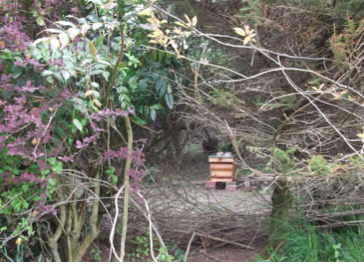
I have twelve hives of bees. Some are on a farm, at the edge of a field in a long strip of woodland. Amid the scrub there is a small tree which in late Spring is a cloud of blossom. I notice it because it sings: the insects that are feeding on it are so tiny, they can only be heard. They greet the nectar with a high, sweet note – pure elation.
Insects originated on our Earth about 480 million years ago. They are thought to have evolved from a group of crustaceans that crawled out of a vast, warm sea into the brackish swamps of our proto-continents. For the next 80 million years, mats of fungi, mosses and liverwort spread and carpeted the drying land. These simple plants relied on the wind for pollination, until they didn’t: we have a fossil of an early conifer from around 280 million years ago which has a flower which would have needed a flying pollinator to seed it.
There have been five major, and countless minor, mass extinctions in our planet’s history. A sixth is currently underway.
In the time since his death I have, like many, been rereading and lamenting the loss of John Burnside. Auks and Aurochs: Essays on Mortality and Extinction (2021) is an essay sequence in which he argues that we have all but lost our innate companionship with other species, “as a living thing alongside other living things ... of being appropriate to other species ... One presence in a continuum of presences”. In this late industrial age, he says, we are only dimly aware of the species with whom we share living space, particularly when they are too small or slight for our sensory apparatus, and our imaginations, to detect.
Burnside makes the parallel argument about the rate of extinction of languages and dialects. As language is homogenised, as variation and its natural fecundity and capacity to seed itself is limited, we lose all that is embedded in it - dialects, cultures, concepts of distance public space, pathways, rituals ... When our ability to express ourselves is enclosed, he says, our interiority is thinned, leaving “an underlying sense of displacement ... a suspicion of lack, and a chronic sense of grief that is never fully expressed”. Burnside quotes Ezekiel: “the chambers of our imagery … all are subject to enclosure”.
Which made me realise that poetry attends to the ecology of language. Change, variability and cross-fertilisation are intrinsic and natural; language as a dynamic, borderless system.
Bees are ‘in’ at the moment (literally and figuratively – it is a cold early Spring up here, they haven’t really started foraging yet). Referencing bees seems to be a quick way to tick the eco box, but the factual inaccuracies drive me nuts. I applaud therefore the poets who address the thick glass wall between the human/non-human worlds, and make our “enclosure” in the human their subject.
In 2015 the Canadian poet Christian Bök published The Xenotext, an experimental sequence that explores the consequences of tampering with a gene sequence (through biogenesis and/or accidental damage) from the inside. Section II, ‘Colony Collapse Disorder’, describes a phenomenon in which the beekeeper opens the hive to find that all the flying bees are gone, leaving the queen and her nursery bees to survive as best they can while the hive is plundered by every sweet-toothed being in the neighbourhood. The causes might be a mix of unseasonal weather, parasites, a chronic lack of forage ... However Bök’s focus is the neonicotinoid pesticides that are used to kill insect pests in the seeds, soil and leaves of arable crops. These act by attacking the insects’ nervous systems, causing long-term genetic damage to the population.
Bök leans heavily on Virgil’s Georgics, though his world is relentlessly apocalyptic.
The afflicted, grey and lean with decay, are borne away on tiers by pallbearers – the ungrieving caretakers bred to clear the waxen cells, whilst survivors loiter, listless from famine in these vestibules, each soul frostbitten by an early chill. Now harken to the keening of the hive: not a wind that sighs amid the aspens nor a tide that blooms upon the oceans, but more akin to some hellish bonfire, trapped within the crucibles of its kiln. [from Stanza 24]
These are tight prose poems of 14 lines, each perfectly rectangular. Yes, it’s not really about the bees, but the mathematical model that propels the sequence does capture the delayed, insidious panic (I imagine) of a whole interwoven ecosystem that suddenly, belatedly finds itself in terminal collapse. One wouldn’t turn to Bök for the science. But, as I’m sure he would argue, that’s not his point.
Sylvia Plath had a hive of bees. Her empathy with the colony, a population of mostly (or in winter entirely) women is, like so much of Plath, incredibly poignant. It is impossible to read Sylvia Plath without thinking of her own mental health issues, her suicide. But here she is an impeccable observer, incredibly attuned to the hive mind (its collective consciousness) and of how the workers - “all women” - exist only to fulfil their role. The three bee poems in Ariel take us from her first trial visit to an apiary to the arrival of her own starter colony (my favourite line - “I have ordered a box of maniacs.”) and into their first winter.
It is almost over.
I am in control.
Here is my honey-machine,
It will work without thinking,
Opening, in spring, like an industrious virgin
(from ‘Stings’)
This is the time of hanging on for the bees – the bees
So slow I hardly know them,
Filing like soldiers
To the syrup tin ...
Now they ball in a mass,
Black
Mind against all that white.
The smile of the snow is white.
It spreads itself out, a mile-long body of Meissen,
Into which, on warm days,
They can only carry their dead.
(from ‘Wintering’)
Images of white or whiteness or blankness recur in her poetry, often linked to fertility, or vanishment of the self. She took up beekeeping in June 1962, and died in February 1963.
The wet dawn inks are doing their blue dissolve.
On their blotter of fog the trees
Seem a botanical drawing –
Memories growing, ring on ring,
A series of weddings.
(from ‘Winter Trees’)
Sean Borodale’s wonderful Bee Journal should be prescribed reading for all aspiring or armchair apiarists. Everything happens: they swarm, they die, they reinvent themselves, all while he learns to do the hardest thing of all – nothing. From its Introduction: “When the wider landscape parches in high summer, this shaded, humid locality divines its insects and flowers; re-builds itself delicately in colour, sugar, water and sunlight”. He understands the life-force of the colony as a manifestation of Lorca’s “duende”:
All that has dark sounds has duende. Those dark sounds are the mystery, the roots that cling to the mire that we all know, that we all ignore, but from which comes the very substance of art ...
Bee Journal came from notebooks he took to the hive: “inside the increased effort of simultaneously writing and ‘keeping’, I experienced a pressure, a slight emergency of the senses”. His poet’s attentiveness allows him into their world. He quickly gave up trying to write while also tending to an open hive, but the poems really do hold what he hopes is “the poetic pulse of the poem in progress”. This “raised alertness” – to the radical geography of the bees’ orbit as well as to the tiny intimacies of the bees themselves – really do capture the experience, including, frequently, “intense incomprehension”. Here is his first colony’s first orientation flight:
Bees in the roof, bees on the walls
stitching the house in a net of flightways,
just like surveillance, just like snoopers
in the open air.
And they rig crack, lump, recess, ridge
to the commune of a memory;
and they rig it
to the low wide little door
of the North in the hive over there;
and they rig it
to our conversation and commentary,
and the brittle sweat’s armada of frightened water
on our brows ...
Yikes.
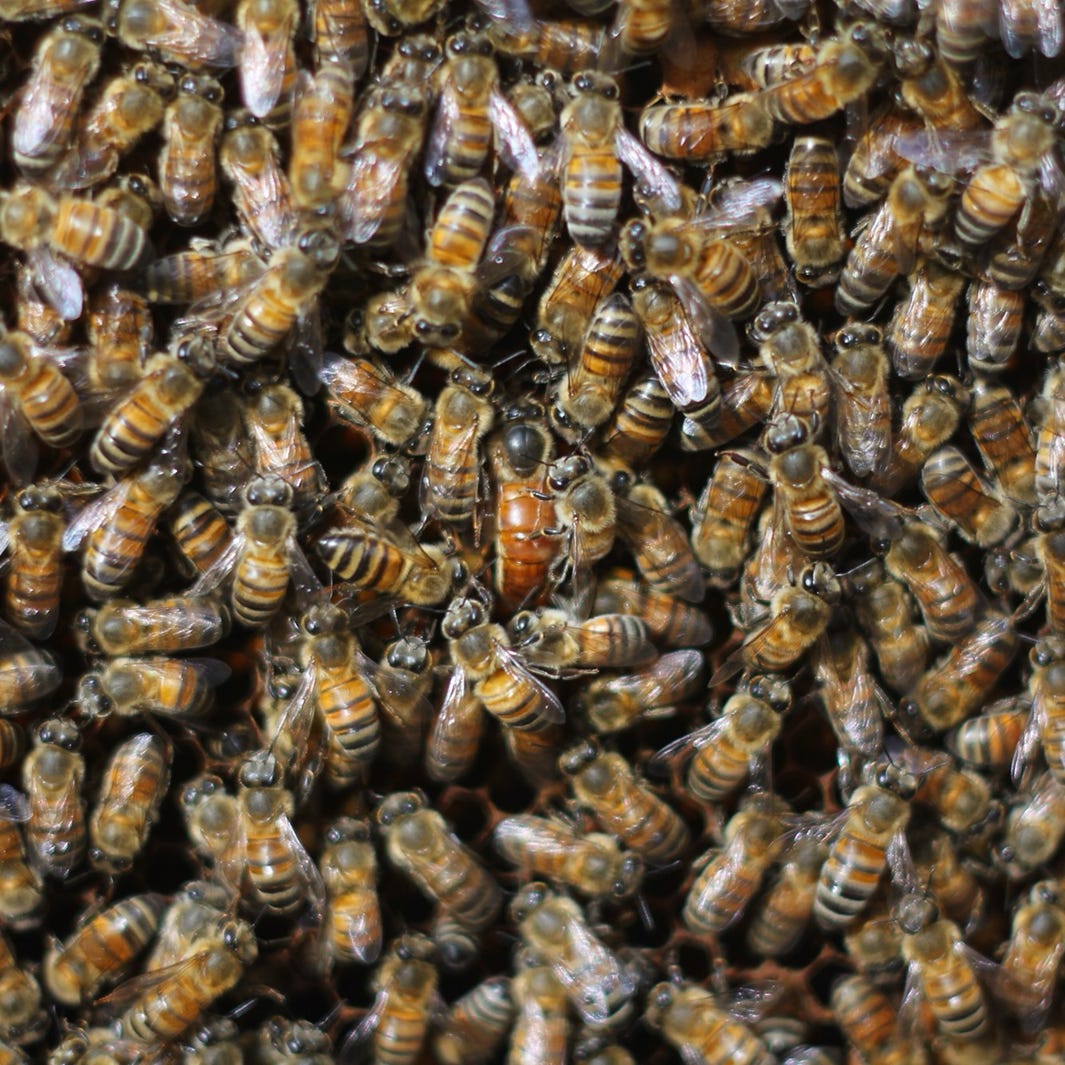
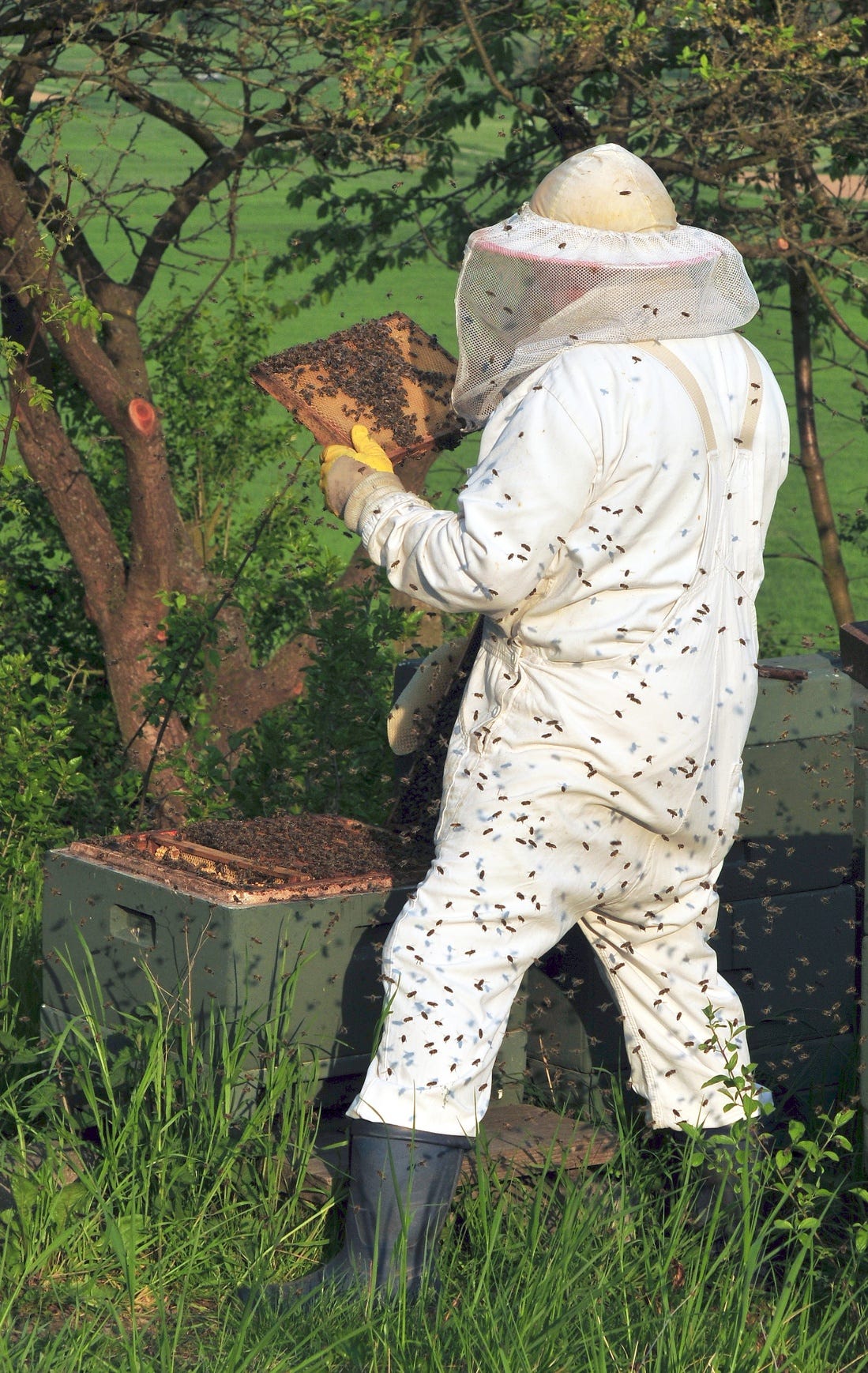
Beekeeping does not repair the ecosystem. Imagine if every insect species received this obsessive attention, this financial investment. I like the honey, but more than anything I like the intimacy. For an hour or three, I am utterly absorbed in the small busyness of the colonies, their gossipings, their standing-no-nonsense. Sounds riffle them: sudden intrusions can cause lasting trauma, a scar in the ‘hive memory’. They are wise and protective. They sense rain and thunder hours away. I have no idea how they express these thoughts to each other. But I hope that in their hummings and dialects it is something like a poem that the bees sustain: an oral/aural membrane between the colony and an increasingly difficult world. This is what I think of with my ear to the hive, listening to the hive sound – their mumming and murmuring, their odd wails and readjustments, until that which preserves the colony within its surroundings is renegotiated and they become almost silent.
More studios and webinars are in the pipeline, so watch this space. Our Substack is free, and subscribers receive advance notice of all workshops, studios, masterclasses and events.
Brilliant post. Fascinating that Plath had her bees for barely one season, 'a swarm in June is worth a silver spoon' [only!], and not long enough to experience the full hive cycle. Wasn't her father a beekeeper and is it possible her writing draws heavily on her observations of bees from childhood?





If the bees outlive us humans wouldn’t that be great! Lovely insights about the intelligence of Insects and the poetic intuition that they share
X
Brilliant post. Fascinating that Plath had her bees for barely one season, 'a swarm in June is worth a silver spoon' [only!], and not long enough to experience the full hive cycle. Wasn't her father a beekeeper and is it possible her writing draws heavily on her observations of bees from childhood?